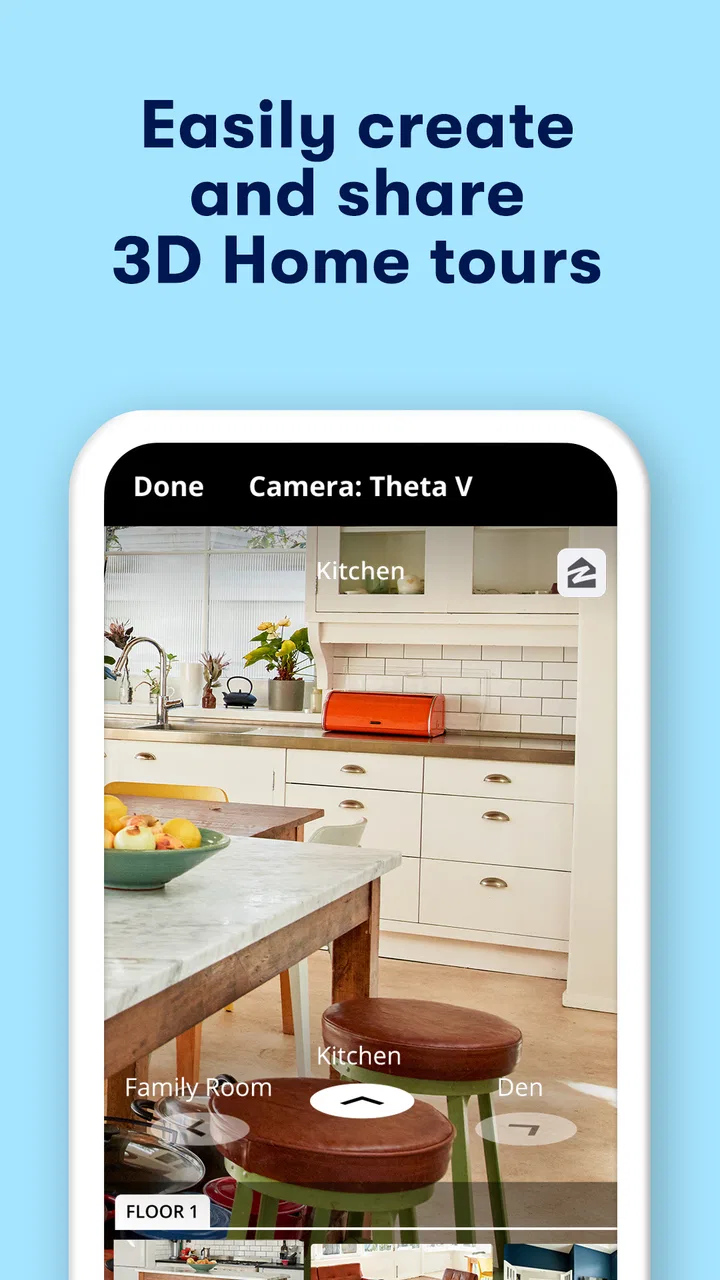
Zillow 3D Home Tours
- 3.9
- Rating
- 100.00K
- Installs
- Free
- Price

 Analysis by App-foxy
When I first opened Zillow 3D Home, I approached it less like a normal property-search tool and more like a way to understand a home before arranging a visit. Its focus is virtual tours for real estate, so the useful question is not simply whether a listing looks attractive. It is whether the tour helps me decide what deserves my time, what needs a closer look, and what can be ruled out from the sofa.
That makes it a practical House & Home app for people comparing properties, preparing for a move, or trying to show a space more clearly. Zillow Group develops it, and the app is free with an Everyone content rating. It has built a modest but meaningful audience, with over 100 thousand installs, a 4.1 average from around 700 ratings, and close to 200 written reviews. Those figures suggest a useful specialist tool rather than an app I would expect every homeowner to need.
From a property search to a clearer first decision
I find that a virtual tour is most useful when I give it a specific job: answering whether a property deserves a closer look, rather than trying to settle the whole decision on a phone. In the next section, I’ll focus on how I pace that first inspection and keep a polished presentation from making me more certain than the evidence warrants.
You May Also Like

 Blood Strike: 2.5 Anniversary
Blood Strike’s Loadouts Turn Every Drop Into a Tactical Gamble
A close look at Blood Strike’s custom loadouts: how fast access to signature weapons reshapes its battle royale rhythm, rewards preparation, and narrows the gap between fights.

 Pandora - Music & Podcasts
Pandora’s Music Is Easy to Start, but Harder to Recover
Pandora’s strength is its low-effort path from a seed to a station. Its weak spot is how much confidence it asks you to place in connection, setup, and quiet recovery.

 8 Ball Pool
 Is Built on Rivalries, Rematches, and Routine
A close look at the rivalries, rematches, shared routines, and unanswered safety questions that turn a quick pool match into a persistent mobile community.

 Samsung Music
’s Quiet Strength Is Playing What You Already Own
Its reach comes less from spectacle than from dependable access to a personal library. That simplicity is both the app’s strongest retention engine and its ceiling.

 AccuWeather: Weather Radar
AccuWeather Review: A Quick, Clear Forecast for Everyday Decisions
For everyday plans, the best forecast is the one you can understand quickly. AccuWeather makes rain timing, radar, and local conditions easy to act on, with a few trade-offs.

 Hill Climb Racing
Why Hill Climb Racing Still Turns Crashes Into One More Run
A tiny car, a bumpy hill and one more upgrade: Hill Climb Racing keeps resurfacing because its simple chaos makes every near-miss feel personal.
More From Our News Desk
View All News


Starting with the right expectation
The first thing I would tell a friend is that this is not a replacement for seeing a property in person. A virtual tour can show flow, room relationships, and general condition more honestly than a line of carefully selected photographs, but it cannot reproduce every detail of a physical visit. Lighting, sound, smells, street noise, surface texture, and the feeling of standing in a room still matter.
Used properly, the app helps with the earlier part of the decision. I can inspect a home when an appointment is inconvenient, revisit a room after forgetting its layout, and compare several properties without relying on memory. That is a different job from signing a lease or making an offer, and the app is strongest when I treat it as a filtering and planning tool.
The practical starting condition is familiar: I have found a property that looks promising, but the photographs leave unanswered questions. Is the living room connected to the kitchen? Does the bedroom really have enough usable space? Is the hallway awkward? Would my desk fit near a window, or is that impression created by a wide-angle image? A 3D tour gives me a chance to investigate those questions before I spend time travelling to the address.
Opening a tour instead of scanning another gallery
Once I reach a listing that includes this kind of presentation, I would begin with a quick pass rather than immediately studying every corner. I look for the overall route through the home, the position of the main rooms, and any areas that seem difficult to understand from still images. This first pass prevents me from getting distracted by decoration before I know whether the layout works for my needs.
The advantage over a conventional photo gallery is continuity. Individual images can make a small room appear generous or hide the relationship between spaces. A tour gives me a more connected view, which is especially valuable in older apartments, split-level homes, and properties with unusual corridors or partially open rooms. That context often changes my opinion faster than another close-up of a kitchen surface.
Still, I would not assume that a tour automatically answers every question. The quality of the source capture matters, and a virtual presentation can contain blind spots. If a corner is not visible, I treat it as an unanswered question rather than filling in the gap with optimism. That habit is one of the most important ways to use the app sensibly.
Following a repeatable inspection route
My preferred workflow is to inspect every property in the same order. I start at the entrance, move through the shared living areas, check the kitchen, then look at bedrooms, bathrooms, storage, and any outdoor or utility spaces that appear. The point is not to imitate an estate agent’s route. It is to make comparisons fair, because a memorable living room should not overshadow a cramped bedroom or missing storage.
On a second pass, I focus on practical movement. I ask whether furniture would block a doorway, whether a dining area is genuinely separate, and whether the route from the entrance to the kitchen would be annoying when carrying shopping. These are small observations, but they are exactly the details that staged photographs often leave out. A tour is more useful when I use it to test my routines rather than admire the room.
A helpful technique is to pause at transitions. I pay attention to where one room ends and another begins, especially around narrow doorways and open-plan areas. If the app lets me inspect the space from a different position, I use that view to judge depth rather than relying on one attractive angle. I also make notes immediately, because after viewing several homes, similar kitchens and neutral walls quickly blend together.
Turning a tour into a short list
After viewing a property, I reduce my notes to three decisions: what works, what needs verification, and what rules it out. For example, a home might have an excellent layout but no obvious place for a washing machine, or a pleasant living space but a bedroom that cannot accommodate the furniture I already own. This turns the tour into an actionable step instead of a passive browsing experience.
That process is particularly useful for remote searches. If I am moving to another city, I can use tours to remove unsuitable properties before asking someone else to visit. A friend, relative, or agent can then spend their time checking a much smaller group. The handoff becomes more efficient because I am passing along specific questions rather than saying only that a listing “looks nice.”
What the app contributes to a shared decision
Property decisions are rarely made by one person alone. A couple may disagree about the kitchen, a parent may need to judge accessibility, or a tenant may need to show a home to someone who cannot attend a viewing. A virtual tour gives everyone a common reference point. Instead of describing the layout from memory, I can guide another person through the same spaces and discuss the same visual evidence.
That does not eliminate disagreement, but it makes the disagreement more concrete. One person may care about the route from the bedroom to the bathroom, while another cares about where a sofa can go. The tour supports both conversations, provided we remember that the screen cannot verify every physical condition.
The strongest benefit is not spectacle; it is fewer wasted decisions. I can reject a property for a clear layout problem, prepare better questions for an agent, or arrive at an in-person viewing with a more focused checklist.
When the workflow changes for someone creating a tour
For a homeowner or property professional, the starting condition is different. The goal is not to inspect a listing but to present a space so that another person can understand it remotely. In that situation, the quality of the result depends on preparation before the tour is made. Rooms should be visually clear, personal clutter should be reduced, and the route should make sense to someone who has never entered the home.
I would prepare the space with the viewer’s questions in mind. A tidy room is helpful, but hiding awkward transitions is not. If a doorway is narrow or a room has an unusual shape, showing that honestly is better than creating an attractive but misleading impression. The best virtual presentation is not the one that makes every room look enormous; it is the one that helps a serious viewer decide whether the property deserves the next step.
Lighting also affects interpretation. A dark corner may look like missing space, while a bright angle may conceal wear. I would therefore inspect the completed tour as a viewer, not merely assume that a captured room looks the same as it did in person. That review stage is an important handoff between creating the material and publishing it for someone else to judge.
Handoffs between viewer, owner, and agent
The app becomes more valuable when it fits into a larger property workflow. A viewer may use it first to shortlist a home, then send questions to an agent. The agent may answer what can be answered from the tour and arrange a physical viewing for the rest. The owner, meanwhile, benefits when the presentation reduces repetitive explanations about the layout.
Each handoff needs clear boundaries. I would not treat a virtual tour as proof of room dimensions, included appliances, building rules, repair history, or current availability. Those details belong in the listing information or in a direct conversation with the responsible person. The tour is visual evidence, not a complete contract.
A useful message to send after viewing is specific: “The second bedroom appears to have space for a single bed, but where is the radiator?” or “The entrance route looks narrow; could you confirm the width?” Questions like these show exactly what the tour helped me understand and exactly where another source is still needed. They also reduce the risk of a disappointing viewing caused by an assumption I made from the screen.
For a family review, I would divide the work. One person can inspect the layout, another can assess storage and furniture placement, and a third can keep a list of questions. This avoids repeatedly reopening the same tour without a purpose. It also makes the final decision more grounded, because each person is checking a different part of daily life.
Comparing it with ordinary property-search habits
The usual alternative is a listing page filled with photographs, a written description, and perhaps a floor plan. Those materials remain important. A floor plan can be better for judging measurements and furniture placement, while photographs can reveal finishes or details that a tour does not show clearly. I would use all of them together rather than choosing one format as universally superior.
Compared with still images, the 3D approach is better at answering “how do these rooms connect?” Compared with a floor plan, it is easier for many people to understand because I can see the spaces as a visitor might experience them. Compared with an in-person visit, it is faster and more convenient, but less reliable for tactile and environmental judgments.
That trade-off explains who should use it. Renters and buyers with long shortlists can save time. People moving from another region can use it to reduce unnecessary travel. Owners and agents can give remote viewers a more useful first impression. On the other hand, someone who already has a small shortlist and lives nearby may gain more from an immediate physical viewing than from repeatedly exploring virtual tours.
A realistic everyday scenario
Imagine that I work full-time and am looking for an apartment after moving to a new area. I find several listings during a lunch break, but the photographs are inconsistent. One has a beautiful kitchen image and no clear view of the hallway; another shows a bedroom from only one corner. I open the available virtual tours in the evening and inspect each home using the same route.
The first property fails because the living room connects to the entrance in a way that leaves little private space. The second looks smaller than expected, but its rooms connect sensibly and the bedroom seems more usable. The third is attractive yet raises questions about storage and the route to the bathroom. I save those questions instead of arranging three unfocused appointments.
Later, I show the second and third tours to a family member. We disagree about decoration, but we can agree on which layout deserves closer attention. I contact the relevant person with questions about dimensions and practical details, then attend one physical viewing with a short list. The app has not made the decision for me; it has improved the order in which I make decisions.
Where the flow breaks
The biggest weakness is that a virtual tour can create confidence faster than it creates certainty. Smooth movement through a home feels persuasive, and that can tempt me to overlook what is outside the camera’s view. I have to remain disciplined about checking dimensions, condition, noise, accessibility, and the surrounding area through other means.
Another point of friction is comparison. Not every property will be presented with the same level of detail, so one listing may feel more convincing simply because its tour is easier to navigate. That does not necessarily mean the home is better. I try to separate presentation quality from property quality and use the tour mainly to judge layout and questions for follow-up.
The app is also not the right choice for someone who wants a complete property transaction inside one place. Its value is visual understanding, not a substitute for communication, legal documents, inspections, or a physical walkthrough. If my decision depends on exact measurements or a close assessment of construction, I would move quickly from the virtual view to a qualified in-person check.
People who dislike exploring spaces on a phone may find the experience less useful than a simple floor plan. A floor plan is often quicker for checking whether furniture will fit, while a tour is better for understanding atmosphere and movement. I would choose according to the question I am trying to answer instead of assuming the richer-looking format is always the most efficient.
Device and account expectations
The app currently appears as version 2026.9.0 and requires at least operating system version 10. That makes the minimum software requirement worth checking before installing, particularly on an older device. On a compatible phone or tablet, I would still prefer a larger screen when studying room relationships, because a small display can make details and transitions harder to judge.
Since it is free, the barrier to trying it is low. I would install it when I expect to compare homes rather than keep it as a permanent background tool. Its usefulness depends on finding properties with suitable virtual presentations, so the experience is naturally strongest during an active search or when preparing a listing.
The Everyone rating also fits the app’s purpose: it is a general real-estate viewing tool rather than entertainment aimed at a narrow age group. In practical terms, that makes it easy to share with household members who are helping with a move, although the final property decision should still be based on adult responsibilities such as budget, condition, and contract terms.
My outcome after using the workflow
My overall impression is that this is a focused app with a clear role. It helps me move from vague interest to a more informed shortlist, especially when photographs leave the layout unclear or when travel makes early viewings difficult. The most effective use is a three-stage process: explore the tour, record concrete questions, and verify the important answers through the listing, the agent, or an in-person visit.
I would recommend it to renters, buyers, and property professionals who need a faster way to understand space. I would not recommend relying on it alone for a final decision, and I would skip it if my only concern is exact measurement or physical condition. Those limits do not cancel its value; they define it.
After its release on October 26, 2020, the app has settled into a useful niche within home-search tools. My honest view is that Zillow 3D Home works best as a bridge between browsing and visiting. It does not replace the human handoff that real estate requires, but it can make that handoff sharper, reduce wasted appointments, and help me arrive at the right questions before I step through the front door.
FAQs for Zillow 3D Home Tours
01What is Zillow 3D Home Tours and how does it work?
Zillow 3D Home Tours is a feature within the Zillow app that allows users to take immersive virtual tours of properties. Using the app, real estate agents and homeowners can create 3D walkthroughs of homes, giving potential buyers the ability to explore the property remotely. This can be particularly useful for out-of-town buyers or during times when in-person visits are limited.
02Do I need any special equipment to create a 3D Home Tour?
To create a Zillow 3D Home Tour, you need a smartphone and the Zillow 3D Home app. For enhanced quality, using a 360-degree camera is recommended. The app guides you through capturing the space, and once uploaded, Zillow processes the images into a seamless 3D tour. This makes it accessible even for those without extensive technical expertise.
03Is Zillow 3D Home Tours free to use?
Yes, Zillow 3D Home Tours is free for both real estate professionals and homeowners. There are no charges to create or host a tour on Zillow's platform. This makes it a cost-effective solution for showcasing properties and reaching a wider audience without additional marketing expenses.
04Can potential buyers access 3D Home Tours without creating an account?
Yes, potential buyers do not need to create an account to view Zillow 3D Home Tours. They can easily access and navigate the tours directly from the property listing on Zillow’s website or app. This ease of access helps in attracting more viewers and providing a comprehensive look at the property.
05How can Zillow 3D Home Tours benefit real estate agents and sellers?
Zillow 3D Home Tours provide a competitive edge by offering virtual, interactive views of a property. This technology can increase visibility, attract more potential buyers, and even reduce the time a home stays on the market. By enabling buyers to explore homes online, it saves time and resources for both buyers and sellers.
Pros
- User-friendly interface for easy navigation.
- High-quality 3D images enhance viewing.
- Smooth integration with Zillow listings.
- Quick upload speeds for 3D tours.
- Supports both iOS and Android platforms.
Cons
- Limited customization for 3D tours.
- Requires stable internet for best use.
- Can be data-intensive on mobile plans.
- Some features need premium subscriptions.
- Occasional bugs in 3D rendering.

Zillow 3D Home Tours
Gallery